


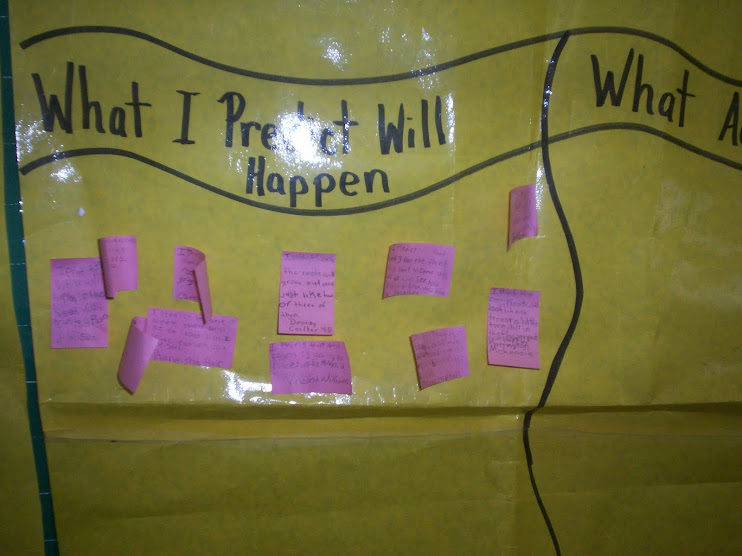


Hypothesis
Can a plant germinate in different biomes, climates, or conditions?
Problem
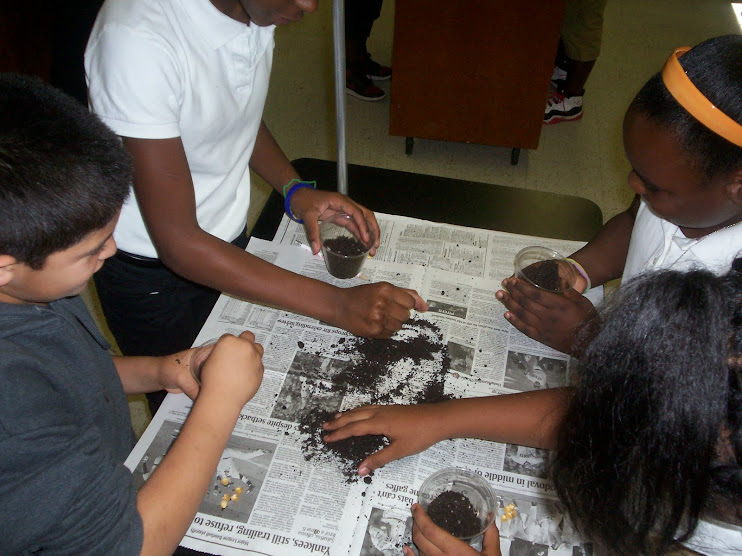
During the experiment, the control group found that there has to be consistency in any environment in order for a plant to germinate and take root, or, it will die.
Materials
Journal
Plastic Cups
1 liter bottle of water
Scissors
Ruler
Bag of River Rock/Gravel
Bag of potting soil/sand
1 liter of pond water
Packets of seeds, beans, yellow corn, peas, ect…
Measuring cup (1-cup)
Zip lock storage bags
Permanent marker
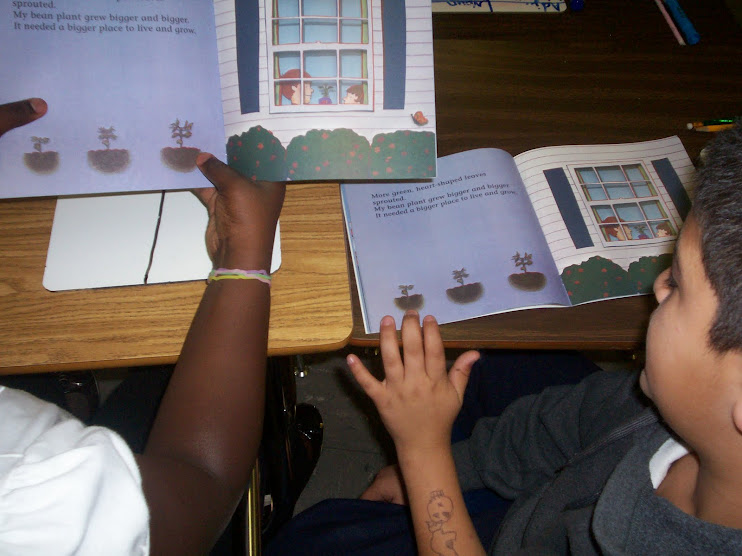
Story: One Bean by Anne Rockwell
Wednesday, December 1, 2010

Dallas ISD 7th Grader's Final Report for Plant Growth
Abstract
Have you ever wondered why certain plants grow in one area, but not in others? This could probably be influenced by the climate, temperature, and availability of water. Fluctuation in temperature and lack of water tend to go hand in hand along with the availability of sun and altitude. In this science project, you will learn about four different biomes, soil, sand, gravel, and pond water; and how climate conditions can affect plant growth.
Objective
This project seeks to investigate the effects of different biomes on plant growth.
Introduction
Let’s take a look at the meaning of biome: a biome is the habitat in which the organism lives. Its climate and region dictates how it germinates based on temperature, availability of water, food, and sunlight. Based upon were a plant grows, the vegetation changes from the south or north. Example, here are a few places where botanist have studied varying biomes of plant life:
1. Rain forest
2. Temperate forest
3. Taiga (boreal forest); and
4. Tundra
In looking at the vegetation world map, we have found that the Desert is the largest biome, and is not good for plant growth. This is probably why the seeds planted in gravel of this science fair project did not succeed. In relation to soil growth, it can be the most productive, or the least. Where nutrients are plenty, plant cycle is strong; but, where it is week, such as a home setting, fertility declines.
For more information regarding this, and other classroom projects on plant growth, please visit www.pbskids.org/zoom/activities/sci/biomeinabaggie.html
Credits
Hort & Crop Science Home
Michelle Maranowski, PhD, Science Buddies
Tuesday, September 14, 2010
Sanders Enterprises hosts 20% V.I.P. Savings Pass For Educators!
Sanders Enterprises wants your business! Wouldn't it be nice if all our favorite places to shop offered us back a percentage of what we spent upon leaving the store just as a way of saying, " Thanks for shopping with us today! Here's a check for 20% of what you've spent." Thanks to local upscale retail store, Macy's, in S.E. Texas, Educators and other consumers can enjoy the value of saving a dollar and making it stretch. Shoppers who have obtained the coveted shopping pass will enjoy 20% extra savings on designer items that almost NEVER go on sale. This crafty sales attraction has spurred Sanders Enterprises the opportunity of having consumers gain the benefit of recycling dollars, and putting the savings where it belongs...back in the customer's pockets. This Independent Business Owner wants you to remember one thing if nothing else...Why shop for savings temporaily when you can do it for yourself and from yourself year-round? Become and Member or IBO and SAVE SAVE SAVE at http://www.amwayglobal.com/TessSanders IBO #5423585.
Tuesday, August 17, 2010
30% Educator Discount!
Experience the value of saving a dollar and making it stretch. Take advantage of discounts up to 30% for your home, family, office, and classroom. Register by Aug. 30, 2010, contact me, and I will give you about 30% off of your entire purchase until December 2011. Shop name brand goods and services such as Best Buy, Office Depot, Sears, Franklin Covey, PetCo, Budget Rental Car, Choice Hotels, and much more.
To register online, you must use your school's name where you are currently employed as a full-time educator. Register at www.quixtar.com, IBO number 5423585. You may also register for membership at www.tsanders14.qhealthbeauty.com or www.tsanders14.qbeautyzone.com.
To register online, you must use your school's name where you are currently employed as a full-time educator. Register at www.quixtar.com, IBO number 5423585. You may also register for membership at www.tsanders14.qhealthbeauty.com or www.tsanders14.qbeautyzone.com.
Wednesday, July 7, 2010
Reflection July 8, 2010-Professionally Teaching
As educators, we have an obligation to teach the whole child without prejudice. We must be diversified, protect integrity, create equilibrium, and most importantly, teach with professionalism. In this article, Teaching Ethics: The Role of the Classroom Teacher, it simply says it best, " Children's character, or moral development, is an important and contoversial topic for for character development." The article goes on to state that schools face an important challenge in doing their part in preparing children to be responsible, productive adults. In short, Teachers are in a key position to directly influence students.
Friday, June 4, 2010
June 1, 2010 Reflection
Reflection 7 & 8
Trying to shift through this week’s reading for Chapter’s 7 and 8 of the text was like trying to shift concrete into powder. There was no “order” to this chaos. Margaret Wheatley, author of Leadership and the New Science, appears to be referencing practices of Scientology, to bring some type of systematic organization to support the publishing of her book. Her attempt at injecting the belief of Scientology prompted me to delve into Christian author, C. S. Lewis, who was a skillful apologist. He was gifted in confronting and proving wrong philosophies that contradict scripture. Wheatley states in Chapter 7, page 117 of Leadership and the New Science, that “chaos has always partnered with order-a concept that contradicts our common definition of chaos…Chaos is the last state before a system plunges into random behavior where no order exists.” In reading, “The Invasion” in the book Mere Christianity Lewis opposes simple religion and proves that Christianity is the true religion. It is one that brings “order” to an “unorganized” world, such as the one referenced in our class text. I will summarize “The Invasion” and give a response to it.
In the chapter entitled, “The Invasion” Lewis combats the idea that simplicity equals truth and he explains the superiority of Christianity over Dualism. This comparison parallels Wheatly’s position regarding deterministic chaos. She states on page 119 that the chaos theory studies a particular variety of chaos known as deterministic chaos. This concept of science became involved in a debate of Philosophy vs. Spirituality. She adds that in a deterministic world, our lives are predetermined based upon what we understand from a biblical point of view. She questions, “free will.” First, Lewis opposes the idea that simplicity equals truth. Lewis confronts what he calls “Christianity-and-water” philosophy. Lewis states this is the idea that “there is a good God in heaven and everything is alright.” This philosophy is too simple because it leaves out the difficult doctrines of scripture. What about hell, sin, and judgment? These issues are never addressed in the name of simplicity or “science”. Simplicity is not
always good. Thus, creating “chaos;” Lewis argues that real things are not simple just like real religion is not simple. To prove his point, he uses various illustrations. He describes how a table looks simple, but if you examine the atoms and make-up of a table it becomes more complicated or chaotic. Lewis also uses the complicated concept of reality to show how difficult some things are to understand, good example, Wheatly’s concepts published in her book.
May 25,2010 Reflection
The Value of Change, Stability, Renewal and Creative Energy: How It Looks in the Differentiated Classroom
Keeping in step with the subject matter presented in chapters 5 and 6, as Educators, we know that change is eminent. In today’s classroom structure, we must become multi-sensory leaders, making every child feel as if they are our favorite. In taking a look at traditional literature, and differentiated literature, we can see how renewed change has created a high level of student energy, and organization. Traditional literature is defined as a body of stories and poems that came into being by way of oral telling from authors unknown. Traditional works are appealing and memorable. They were passed down from generation to generation without the aid of being written. Traditional tales and poems make up an important part of children’s literature.
Keeping in step with the subject matter presented in chapters 5 and 6, as Educators, we know that change is eminent. In today’s classroom structure, we must become multi-sensory leaders, making every child feel as if they are our favorite. In taking a look at traditional literature, and differentiated literature, we can see how renewed change has created a high level of student energy, and organization. Traditional literature is defined as a body of stories and poems that came into being by way of oral telling from authors unknown. Traditional works are appealing and memorable. They were passed down from generation to generation without the aid of being written. Traditional tales and poems make up an important part of children’s literature.
Subscribe to:
Posts (Atom)


